
Hello Affiliates,
Welcome to today’s special feature newsletter!
As an International Document Specialist, one of the most common hurdles you will encounter during client intake is confusion over translation types.
Clients frequently come to you saying, “I need an official translation,” but they often don’t know whether their specific entity requires a Certified, Notarized, or Sworn translation.
Recommending the wrong format can lead to consulate rejections, wasted fees, and severe delays.
Today, we are breaking down the exact differences between these three terms so you can guide your clients with absolute confidence and protect your reputation.
Decoding the Big Three: What’s the Difference?
1. Certified Translation
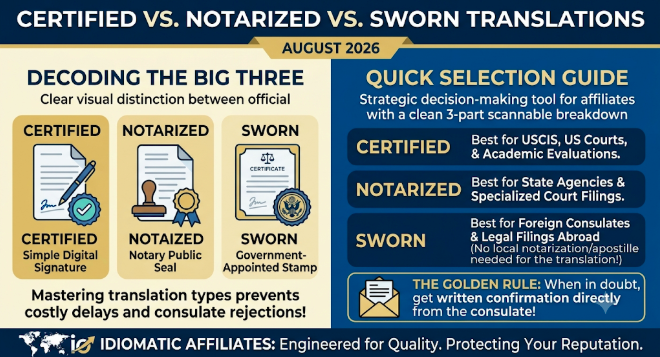
- What it is: A translation accompanied by an official Statement of Accuracy (a cover sheet or certificate) completed by a qualified translator or translation agency.
- The Key Detail: It is signed with a simple digital signature attesting that the translation is a true and correct representation of the source document.
- When it’s used: Commonly required by official bodies in the US (such as USCIS for immigration, universities, courts, and standard credential evaluations).
2. Notarized Translation
- What it is: A Certified Translation that takes quality assurance a step further.
- The Key Detail: The translator or authorized agency representative signs the Statement of Accuracy in the presence of a Notary Public, who then places their legal seal and signature on the certification block.
- When it’s used: Required by certain state agencies, foreign consulates, academic institutions, or courts that demand third-party identity verification of the person signing the translation certificate.
3. Sworn Translation (Official Translation)
- What it is: A translation performed exclusively by an officially appointed, government-approved sworn translator (such as those recognized by a foreign country’s Ministry of Foreign Affairs).
- The Key Detail: The sworn translator holds official legal authority. Because their seal and signature are registered directly with the government, a sworn translation does NOT need to be notarized or apostilled to be legally valid in that destination country.
- When it’s used: Heavily required by foreign governments and consulates (e.g., in Spain, Italy, France, Germany, or Brazil) for official legal procedures, visa applications, and citizenship filings.
Comparison Cheat Sheet
| Feature | Certified Translation | Notarized Translation | Sworn Translation |
| Signature Type | Simple Digital Signature | Wet/Notarized Signature | Government-Appointed Stamp & Signature |
| Requires Notarization? | No | Yes | No |
| Requires Apostille? | Depends on destination | Depends on destination | No |
| Best For | USCIS, US Courts, Universities | Specific US state/court filings | Foreign Consulates & Ministries Abroad |
How to Use This in Your “Reseller Play”
When a client brings you foreign documents, use your intake script to lock down the exact service they need before placing the order through your dashboard:
- Ask the Target Entity: “Is this document staying in the US (e.g., USCIS), or is it going to a foreign consulate abroad?”
- Apply the Sworn Exception: If it’s going abroad to a country requiring a Sworn Translation, explain: “We can provide a Sworn Translation directly. Because it is completed by a government-appointed translator, you get to skip the extra cost and delay of local notarization and apostilles for the translation itself!”
- Calculate Your Margin: Open your mobile calculator shortcut, select the appropriate wholesale rate, add your Model 2 Reseller Markup ($30–$50 convenience fee), and invoice your client directly as their single, trusted point of contact.
The Golden Reminder: Get It in Writing
While Idiomatic can easily fulfill Certified, Notarized, and Sworn translations for almost any country, remember: we aren’t mind readers, and consulate rules can shift without notice.
The only authority that knows the precise requirements 100% of the time is the receiving entity itself.
When in doubt, always instruct your client to get written confirmation from their consulate or receiving authority specifying whether they require a Certified, Notarized, or Sworn translation.
Your Action Item Today
Save this email or print the comparison cheat sheet above for your desk!
The next time a client asks for an “official translation,” use these three definitions to diagnose their exact need instantly, positioning yourself as an indispensable workflow expert.
Have a tricky file and not sure if it requires a Sworn Translation?
- Check rates on your dashboard: Log in at idiomaticaffiliates.com
- Ask our compliance desk: [email protected]
- Book a 1-on-1 strategy call: Book a 30-Minute Strategy Session Here
To your growing expertise,
Gabe and the Idiomatic Affiliates Team
Leave a Reply