Hello Affiliates,
Welcome to this week’s newsletter!
As an International Document Specialist, handling apostilles alongside translations is one of your most lucrative revenue streams.
However, it is also the area where even experienced affiliates make costly sequencing mistakes.
The most common panic call we receive sounds like this: “We translated the birth certificate, but the consulate rejected it because the apostille wasn’t on it yet!”
Today, we are breaking down the exact, non-negotiable step-by-step workflow for apostilles and translations so you can protect your client’s timeline, guarantee compliance, and position yourself as the ultimate workflow expert.
The Golden Rule: Original Apostille ALWAYS Comes First
When a client needs an apostilled document translated (e.g., a US birth certificate for use in Spain), the first step is NEVER the translation.
Why?
An apostille is a legal certificate attached to the original document by the Secretary of State (or relevant governing body).
The apostille itself contains critical legal text, seals, and tracking numbers.
If you translate the birth certificate before it gets apostilled, the final translated package will missing the translation of the apostille itself.
Foreign authorities and consulates will reject the entire file because the translation package is incomplete!
The Standard 3-Step Apostille Workflow
Here is the exact order of operations you must follow for every standard file:
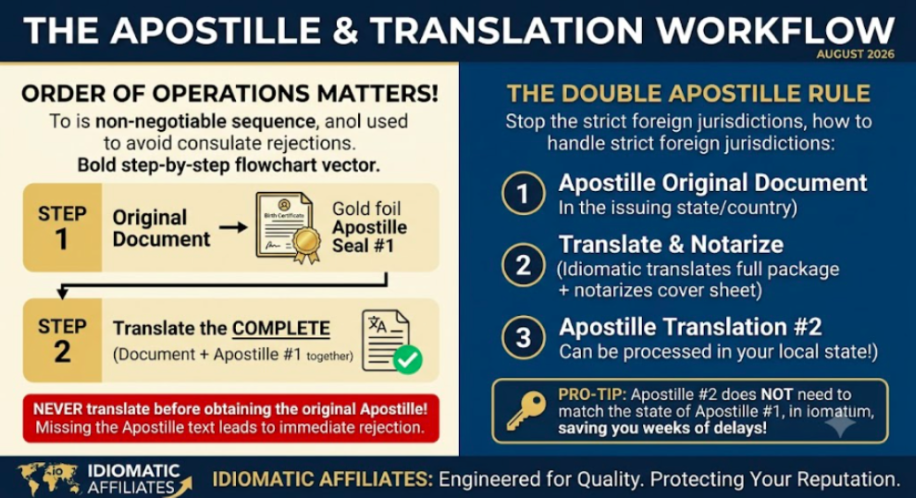
- Step 1: Obtain the Apostille on the Original Document
Send the original civil document (birth certificate, FBI check, corporate document) to the issuing state/government authority to receive its official Apostille seal. - Step 2: Translate the Complete Package (Original + Apostille)
Once the original document has its apostille attached, hand the entire bundled package to Idiomatic. Our certified team translates both the core document and the attached apostille page together. - Step 3: Client Submission
The fully translated package is ready for official submission to the target consulate or foreign entity.
What If the Translation ALSO Needs an Apostille?
In certain strict jurisdictions, foreign governments demand a “Double Apostille”—meaning both the original document and the translation’s notarized cover sheet require an Apostille.
Even in this scenario, the rule remains: Start with the original document’s apostille first.
The Double Apostille Sequence:
- Apostille #1: Get the Apostille on the original document.
- Translation & Notarization: Idiomatic translates the entire package (document + Apostille #1). The translation cover sheet is then notarized.
- Apostille #2: The notarized translation cover sheet is sent to get its own Apostille.
Pro-Tip for Affiliates:
Apostille #2 (the translation’s apostille) does NOT need to be conducted in the same state as Apostille #1!
For example, if the original birth certificate was apostilled in New York (Apostille #1), but your notary or Idiomatic’s translation notarization occurs in Florida, Apostille #2 can be processed directly in Florida. This flexibility saves you time and massive logistical headaches.
How to Use This in Your “Reseller Play”
When a client walks in needing an apostille and translation bundle, take complete control of the project:
- Explain the Timeline: “To make sure your package isn’t rejected by the consulate, we must process the apostille on your original document first. Once that seal is issued, we will translate the complete file.”
- Bundle the Pricing: Use your home-screen calculator shortcut to check our wholesale translation rate, add your state apostille processing fees, and include your Model 2 Reseller Markup ($50+ convenience fee).
- Collect and Execute: Invoice the client for the full package directly. You handle the workflow sequence seamlessy, saving them weeks of potential back-and-forth delays.
Remember: Verify Foreign Requirements First
While this workflow sequence is universal, whether a foreign entity requires a standard Certified Translation, a Sworn Translation, or a Double Apostille depends entirely on their local laws.
As always, if your client is unsure, have them get written confirmation directly from their receiving consulate or foreign attorney before initiating the apostille chain.
Your Action Item Today
Update your intake intake workflow notes: Apostille First, Translate Second.
Memorizing this single sequence will eliminate 90% of foreign document rejection risks for your business!
Have a complex multi-state apostille file on your desk right now?
- Check your active dashboard orders: Log in at idiomaticaffiliates.com
- Email our apostille & compliance desk: [email protected]
- Let’s map out your apostille workflow 1-on-1: Book a 30-Minute Strategy Session Here
Good luck!
Gabe and the Idiomatic Affiliates Team
Leave a Reply