Hello Affiliates,
Last week, we opened a massive conversation about the shifting requirements for Spanish educational documents.
The engagement was incredible, but it also revealed a lot of confusion regarding what is actually “legal” in the eyes of the Spanish Ministry of Education in 2026.
Today, I want to provide a critical follow-up.
If you have a client headed to Spain, you need to understand that digital convenience is currently the enemy of approval.
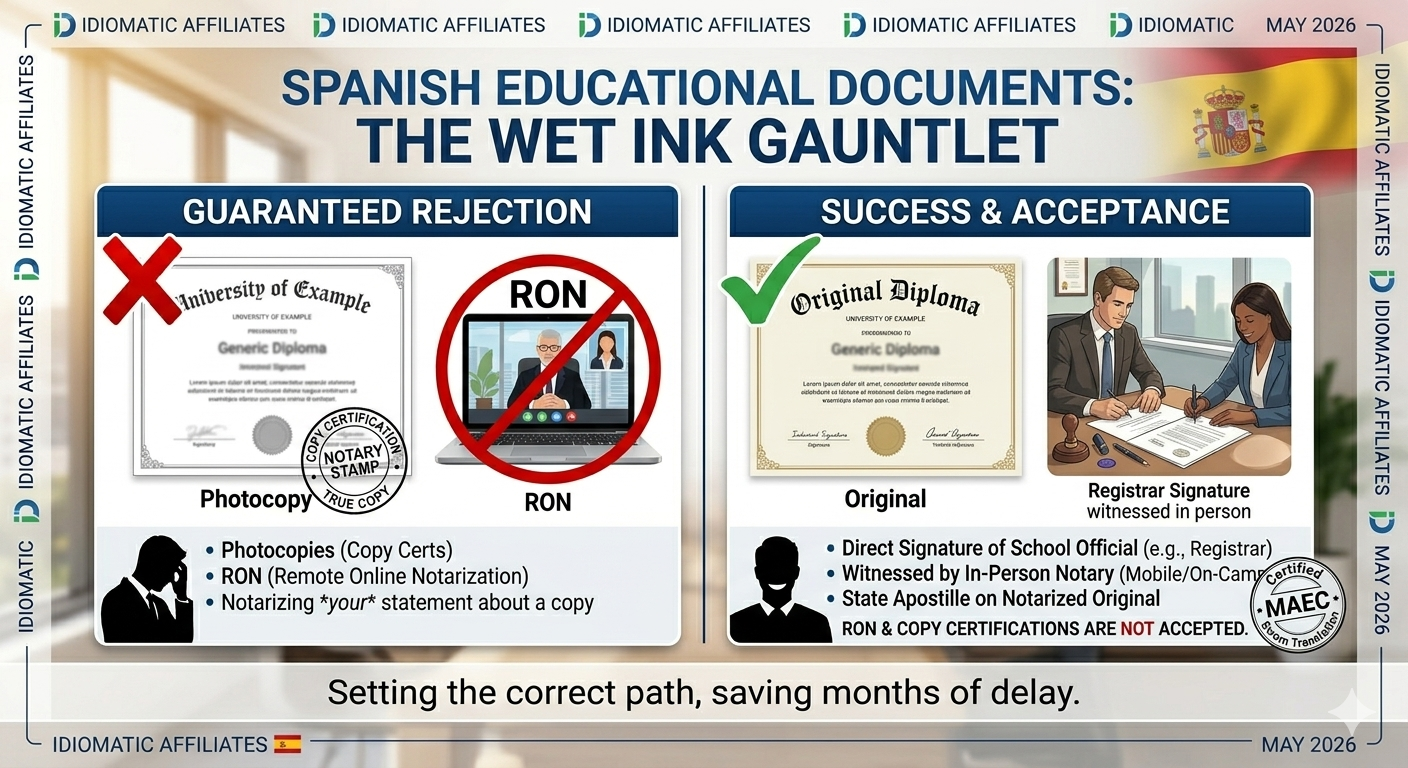
The “Wet Ink” Reality: No RON, No Copy Certs
To elaborate on last week’s update: Spain has moved to a strictly direct “Chain of Authentication.” This means the traditional shortcuts many of us have used for years are now leading to guaranteed rejections at the consulate level.
- RON is NOT an Option: Because the requirement is that the School Registrar must physically sign the document in front of a notary to prove it is an original, Remote Online Notarization is off the table. Spanish authorities want to see physical evidence of the seal and “Wet Ink” signatures.
- The Death of “Copy Certifications”: You can no longer notarize a photocopy of a diploma as a “true copy.” The School Official must be the one to sign the document (the original or an official replacement), and the notary must notarize that official’s signature directly.
- The Only Path: This requires either an on-campus notary or a mobile notary physically meeting the Registrar at the school. This is the only way to get a physical state Apostille that Spain will accept.
It is a “pain in the neck” and takes longer to complete, but setting this expectation now saves your client from a nightmare rejection later.
The Sworn Translation: Your Final “Hassle-Free” Step
Once your client has jumped through the hoops of getting that “Wet Ink” notarization and the physical Apostille, they can breathe.
This is where we take the wheel and make the process easy again.
What is a Sworn Translation (Traducción Jurada)? In Spain, a Sworn Translator is an official appointed by the Spanish Ministry of Foreign Affairs (MAEC).
Their stamp and signature carry the weight of a legal attestation.
- No Notarization or Apostille Needed: One of the biggest perks of our service is that once our MAEC-registered translator signs and stamps the document, it is legally done.
- Guaranteed Acceptance: Because the translator is already a Spanish “official,” their work does not need to be notarized or apostilled again. It is ready for immediate submission to the consulate or the Ministry in Spain.
- The Finish Line: When you hand the Sworn Translation to your client, the “chain” is complete.
Knowledge is Your Competitive Advantage
Sharing this information isn’t about making things sound difficult—it’s about making you the most valuable person in your client’s relocation journey.
When you can explain why a copy certification will fail before they spend the money, you earn a client for life.
Do you have a complex academic case on your desk?
- Email the team: [email protected]
- Let’s map it out: If your client has degrees from multiple states and needs a clear workflow, book a 1-on-1 with me here.
To your growth and expertise,
Gabe and the Idiomatic Affiliates Team


Leave a Reply