Hello Affiliates,
Welcome to this week’s feature update!
In our industry, it is easy to view notarizations, apostilles, and certified translations in isolation as individual transactions. In reality, each of us is an essential link within a broader cross-border ecosystem.
When an applicant reaches your desk or submits an order through Idiomatic, they usually know what administrative document they need.
But rarely do we get a front-row seat to the very first link in that chain: the relocation strategist who designs their roadmap, guides them to your counter, and walks them through foreign authorities abroad.
This week, we are thrilled to feature a guest article from one of our trusted external collaborators, Bella Jabra, Founder and CEO of Reloca Spain.
Bella is on the front lines guiding hundreds of Americans moving overseas, and she is pulling back the curtain on the “why” behind the documents passing through your hands—how they are scrutinized in Spain, why proper sequencing matters, and how you can monetize these relocation journeys beyond a single stamp.
Here is Bella’s breakdown:
The Spain Move Is Sending You Clients. Here’s What Happens to Your Apostilles Next.
October 28th, 2026
Hey notaries and apostille agents,
Spain is the most requested move I see from Americans right now, and your clients are part of that wave. You already know how to notarize and apostille a document. What most people in our industry never get to see is where that document goes next, and why the person across the counter needs it.
This post closes that gap. If you notarize or apostille documents for a living, it will help you answer the “why” questions your clients ask, and show you a simple way to earn from the Spain moves already passing through your desk.
Who I am
I’m Bella Jabra, an American who moved to Spain seven years ago. I have lived in Madrid, Murcia, Sevilla, and Valencia, and I did all of it the hard way, before anyone explained which documents I needed, in what order, or why.
That is why I started Reloca Spain. I help Americans plan and complete their move to Spain, from choosing the right visa to landing and getting settled. Visa filings go through a licensed immigration lawyer, and I stay with each client through the whole process so nothing falls through the cracks.
Why your clients need these documents
Most Americans moving to Spain apply for a visa at a Spanish consulate before they ever board a plane. The consulate does not take a client’s word for anything. It wants proof, and that proof arrives as documents: an FBI background check, birth and marriage certificates for family members, notarized bank certificates, diplomas, and more.
Spain and the United States both belong to the Hague Apostille Convention. The apostille is what tells a Spanish official that a US document is real, so they can accept it without further checks. Without it, the document is just paper.
That is the part your clients rarely understand. They see an extra fee and an extra errand. The consulate sees the one stamp that decides whether the application moves forward or gets sent back. Requirements vary by consulate and visa type, so the details matter, but the principle is the same every time.
Where you fit in a Spain move
Your work is one step in a longer chain, and the order of the chain is where clients get tripped up.
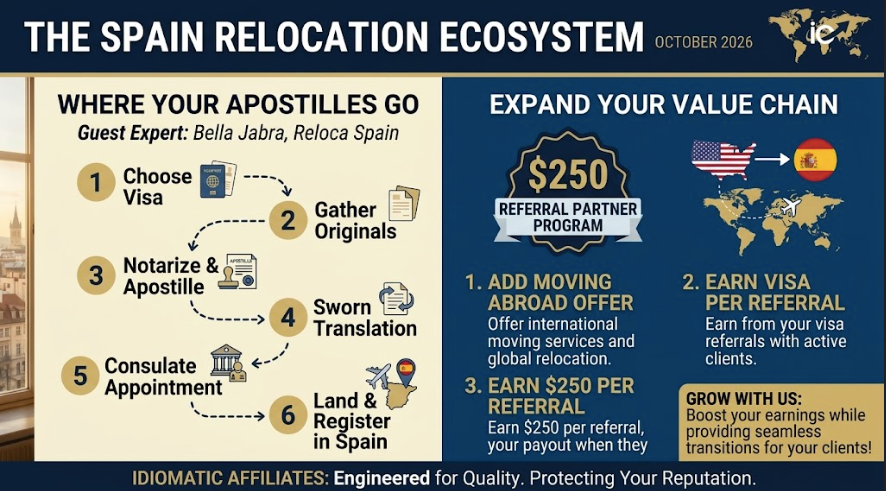
- Choose the visa. The pathway (non-lucrative, digital nomad, student, and others) decides which documents the consulate asks for.
- Gather the originals. Background checks, civil records, and signed statements, each from the right issuing office.
- Notarize and apostille. This is you. State documents are apostilled at the state level, and federal documents such as the FBI check go through the US Department of State.
- Translate into Spanish. Spanish authorities generally require translations done by a sworn translator, and the apostille is usually translated too.
- Attend the consulate appointment. Anything wrong, expired, or out of order can mean a delay or a rejection.
- Land and register. After arrival, the client applies for their residency card and registers their address with the local town hall.
When a client asks why the apostille has to happen before the translation, or why a plain copy is not enough, you now have a clear answer.
What I do for your clients
You handle the stamp. I handle everything around it, so your client does not have to figure out the rest alone.
- Visa pathway selection based on their income, work and timeline.
- A personal timeline that shows what happens when, so documents are gathered in the right order and not left to expire.
- Visa filing support through a licensed immigration lawyer.
- Housing, banking and arrival help once they land in Spain.
- City and neighborhood selection so they choose where to live based on budget, lifestyle and work, not guesswork.
- Document guidance on what to gather, from whom, and in what order, so nothing is rejected at the consulate.
- Rental search and lease review to help them avoid bad contracts.
- Regular check-in calls so they always know their next step.
The result is a client who arrives already knowing why they need an apostille, and who comes back to you for the next one.
What’s in it for you
As a notary or apostille agent, you already sit at the exact moment a client commits to a move. That moment is worth more than a single stamp. Here are three ways to use it:
- Add a “moving abroad” offer. Pair your apostille service with my free Ultimate Spain Relocation Guide, which you are welcome to share with your clients, and position yourself as the expert who knows the whole process, not only one step.
- Refer clients who need more than a stamp. When a client asks about visas, timing or what to do in Spain, send them to me. I will take it from there and keep you in the loop.
- Earn from it. I run a referral program for partners who send me clients. You earn $250 for every referred client who signs with me and completes payment.
You keep your client, you look like the person with all the answers, and you earn on a service you are not providing yourself.
Let’s talk
Is this something that could fit into your service offering? If so, I would love to hear from you.
Email me at [email protected] and ask about the referral program, or see everything I do at relocaspain.com.
To your clients’ next chapter in Spain!
Un saludo,
Bella Jabra
Founder & CEO
Reloca Spain LLC
Leave a Reply