Hello Affiliates,
Welcome to this week’s feature update!
As our affiliate network continues to expand, maintaining absolute clarity around project expectations—both for you and your end clients—is one of our top priorities.
Today, we want to discuss an important distinction regarding document formatting vs. linguistic accuracy, explain why official translation standards strictly regulate layout, and highlight a recent update to our order form Terms & Conditions.
Linguistic Accuracy First: Translators, Not Graphic Designers
At Idiomatic, our primary mission is delivering court-accepted, legally binding, and foreign-ministry-compliant translations.
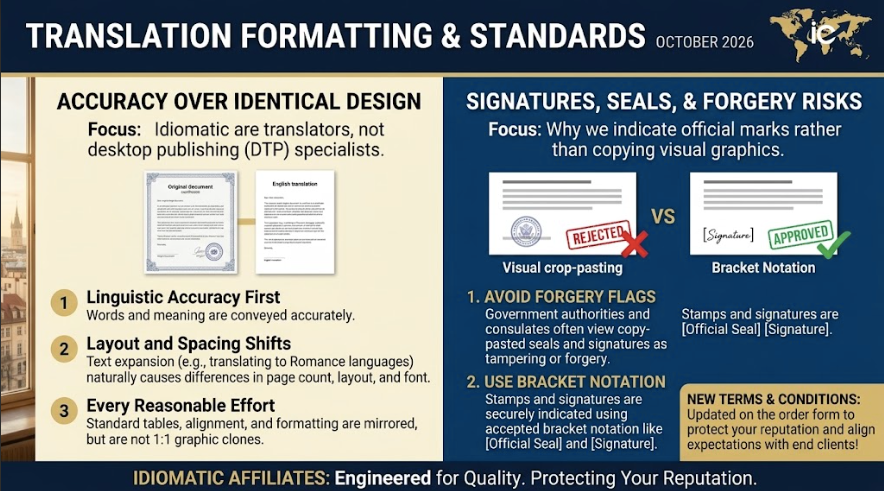
First and foremost, we are professional translators, not desktop publishing (DTP) specialists.
While our team always makes every reasonable effort to preserve the visual structure and layout of the source file—mirroring tables, section headers, and alignment whenever feasible—the core deliverable is the accurate translation of content, meaning, and legal intent.
What Your Clients Should Expect:
- Text Expansion & Layout Shifts: Different languages require different word counts. A English document translated into Spanish or Italian often expands in text volume by 15% to 25%. Consequently, line breaks, paragraph height, font size, and overall page count may naturally differ from the original source file.
- Typographical Variations: Fonts and spacing are adjusted for legibility and legal formatting standards, meaning the translation layout will not always be a 1:1 visual clone of the original document.
Why Copy-Pasting Seals & Signatures is a Rejection Risk
A frequent request from end clients is to have graphics, seals, signatures, or official logos digitally extracted (“cropped and pasted”) from the original document into the translation.
Here is why we strictly follow official certification guidelines instead:
- Anti-Forgery Regulations: Many domestic courts, state agencies, and foreign consulates consider inserting raw graphic images of official stamps or signatures into a translation to be tampering or forgery.
- Standard Legality Indications: Official translation standards dictate that non-text elements must be indicated using standard brackets and descriptive notation (e.g., [Official Seal: Department of Public Health], [Illegible Signature], [State Revenue Stamp]).
- Preserving Validity: Using proper bracket notation ensures the translation is legally valid and recognized by official authorities, preventing unexpected consulate rejections.
Updated Terms & Conditions on Your Order Form
To ensure total transparency across our network and protect both your reputation and ours, we have updated the Terms & Conditions on our affiliate order form to explicitly detail our formatting guidelines.
When submitting orders, clients and affiliates will see these expectations clearly outlined, — and must agree to them — guaranteeing that everyone is aligned on deliverables prior to processing.
How to Set Expectations with Your Clients
When onboarding clients with complex or heavily formatted documents (such as diplomas, transcripts, or intricate legal contracts), follow this simple communication strategy:
- Emphasize Compliance Over Design: Explain to the client that receiving authorities require accurate, legally formatted translations rather than exact visual graphic replicas.
- Highlight Legal Notation: Reassure them that seals, stamps, and signatures are properly documented using recognized legal brackets ([Seal], [Signature]) so foreign officials accept the filing without hesitation.
- Review Special Formatting Needs Early: If a client has specific structural constraints, note them during intake. We will accommodate all reasonable requests provided they do not violate official translation standards or legal certification rules.
We Are Here to Support Your Filings
By setting clear, professional expectations upfront, you reinforce your authority as an international document expert while delivering seamless, stress-free outcomes for your clients.
Have questions about a specific document layout or formatting requirement? Reach out to our compliance team before placing your order!
- Generate quotes & submit orders: Log in at idiomaticaffiliates.com
- Email our compliance desk: [email protected]
- Book a 1-on-1 strategy call: Book a 30-Minute Strategy Session Here
To your expertise, transparency, and growing network,
Gabe and the Idiomatic Affiliates Team
Leave a Reply